
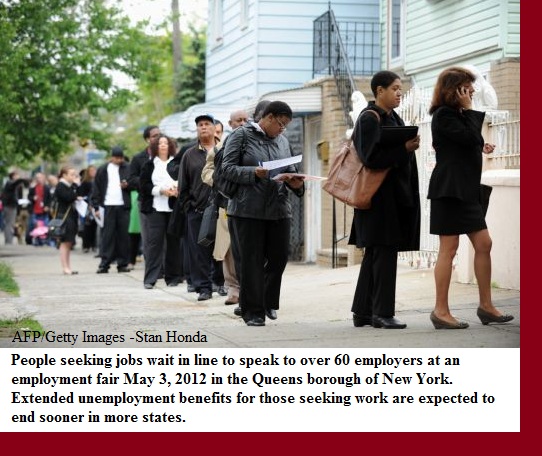
U.S. unemployment rate for May 2012 is 8.2%
African American male unemployment increases to 14.2%
By Dilemma X
Source: U.S. Bureau of Labor Statistics
Nonfarm payroll employment changed little in May (+69,000), and the unemployment rate was essentially unchanged at 8.2 percent, the U.S. Bureau of Labor Statistics reported today. Employment increased in health care, transportation and warehousing, and wholesale trade but declined in construction. Employment was little changed in most other major industries.
The number of persons employed part time for economic reasons (sometimes referred to as involuntary part-time workers) edged up to 8.1 million over the month. These individuals were working part time because their hours had been cut back or because they were unable to find a full-time job.
Construction employment declined by 28,000 in May, with job losses occurring in specialty trade contractors (-18,000) and in heavy and civil engineering construction (-11,000). Since reaching a low in January 2011, employment in construction has shown little change on net.
Health care employment continued to increase in May (+33,000). Within the industry, employment in ambulatory health care services, which includes offices of physicians and outpatient care centers, rose by 23,000 over the month. Over the year, health care employment has risen by 340,000.
Transportation and warehousing added 36,000 jobs over the month. Employment gains in transit and ground passenger transportation (+20,000) and in couriers and messengers (+5,000) followed job losses in those industries in April. Employment in both industries has shown little net change over the year. In May, truck transportation added 7,000 jobs.
Past May unemployment rates:
The number of unemployed persons increased by 787,000 to 14.5 million.
Between January 2009 and March, 2009 more than 2 million jobs were lost and 663,000 were lost in March 2009 alone. The number of unemployed persons increased to 13.2 million that month
African American unemployment for February 2012 was 14.1% (Seasonally adjusted)
African American unemployment for January 2012 was 13.6% (Seasonally adjusted)
African American unemployment for December 2011 was to 15.8% (Seasonally adjusted)
African American unemployment for November 2011 was 15.5% (Seasonally adjusted)
African American unemployment for October 2011 was 15.0% (Seasonally adjusted)
African American unemployment for September 2011 was 15.9% (Seasonally adjusted)
African American unemployment for August 2011 was 16.7% (Seasonally adjusted)
African American unemployment for July 2011 was 15.9% (Seasonally adjusted)
African American unemployment for June 2011 was 16.2% (Seasonally adjusted)
African American unemployment for May 2011 was 16.2% (Seasonally adjusted)
African American unemployment for April 2011 was 16.1% (Seasonally adjusted)
African American unemployment for May 2010 was 15.3% (Seasonally adjusted)
African American unemployment for men 20 years and over
October 2011 was 16.0% (Seasonally adjusted)
September 2011 was 16.6% (Seasonally adjusted)
August 2011 was 18.0% (Seasonally adjusted)
July 2011 was 17.0% (Seasonally adjusted)
June 2011 was 17.0% (Seasonally adjusted)
May 2011 was 17.5% (Seasonally adjusted)
April 2011 was 17.0% (Seasonally adjusted)
May 2010 was 17.0% (Not seasonally adjusted).
September 2009 was 15.5% (Not seasonally adjusted).
August 2010 was at 17.3%
African American unemployment for women 20 years and over
October 2011 was 12.6% (Seasonally adjusted)
September 2011 was 13.2% (Seasonally adjusted)
August 2011 was 13.4% (Seasonally adjusted)
July 2011 was 13.4% (Seasonally adjusted)
June 2011 was 13.8% (Seasonally adjusted)
May 2011 was 13.4% (Seasonally adjusted)
April 2011 was 13.4% (Seasonally adjusted)
May 2010 was 12.0% (Not seasonally adjusted).
September 2009 was 13.4% (Not seasonally adjusted).
August 2010 was 13.2%
African American unemployment for both sexes, 16 to 19 years
October 2011 was 37.5% (Seasonally adjusted)
September 2011 was 43.6% (Seasonally adjusted)
August 2011 was 46.3% (Seasonally adjusted)
July 2011 was 39.2% (Seasonally adjusted)
June 2011 was 39.9% (Seasonally adjusted)
May 2011 was 40.7% (Seasonally adjusted)
April 2011 was 41.6% (Seasonally adjusted)
May 2010 was 38.4% (Not seasonally adjusted).
September 2009 was 40.7% (Not seasonally adjusted).
August 2010 was 45.4%
________________________________________________________
White unemployment
October 2011 was 8.0% (Seasonally adjusted)
September 2011 was 7.9% (Seasonally adjusted)
August 2011 was 7.9% (Seasonally adjusted)
July 2011 was 7.9% (Seasonally adjusted)
June 2011 was 8.1% (Seasonally adjusted)
May 2011 was 7.9% (Seasonally adjusted)
May 2010 was 8.4% (Seasonally adjusted)
White unemployment for men 20 years and over
March 2012 was 6.8% (Seasonally adjusted)
October 2011 was 7.8% (Seasonally adjusted)
September 2011 was 7.7% (Seasonally adjusted)
August 2011 was 7.7% (Seasonally adjusted)
July 2011 was 7.9% (Seasonally adjusted)
June 2011 was 8.1% (Seasonally adjusted)
May 2011 was 7.9% (Seasonally adjusted)
April 2011 was 7.9% (Seasonally adjusted)
May 2010 was 8.4% (Not seasonally adjusted).
September 2009 was 8.7% (Not seasonally adjusted).
August 2010 was 8.9%
October 2011 was 7.0% (Seasonally adjusted)
September 2011 was 7.1% (Seasonally adjusted)
August 2011 was 7.0% (Seasonally adjusted)
July 2011 was 7.0% (Seasonally adjusted)
June 2011 was 7.1% (Seasonally adjusted)
May 2011 was 7.1% (Seasonally adjusted)
April 2011 was 7.0% (Seasonally adjusted)
May 2010 was 7.0% (Not seasonally adjusted).
September 2009 was 7.2% (Not seasonally adjusted).
August 2010 was 7.1%
October 2011 was 21.7% (Seasonally adjusted)
September 2011 was 21.2% (Seasonally adjusted)
August 2011 was 22.8% (Seasonally adjusted)
July 2011 was 23.0% (Seasonally adjusted)
June 2011 was 21.8% (Seasonally adjusted)
May 2011 was 20.7% (Seasonally adjusted)
April 2011 was 22.3% (Seasonally adjusted)
May 2010 was 25.1% (Not seasonally adjusted).
September 2009 was 23.0% (Not seasonally adjusted).
August 2010 was 23.8%
Not Seasonally Adjusted
Seasonal adjustment is a statistical method for removing the seasonal component of a time series used when analyzing non-seasonal trends. Whereas, not-seasonally-adjusted reflects the actual current data. It is normal to report not-seasonally-adjusted data for current unemployment rates. Seasonally adjusted data may be used for the longer term comparison.
Total employment and unemployment vary throughout the year. For example,higher unemployment in January and February isn’t uncommon because of work in agriculture, construction and other seasonal industries slowing down. Also, both employment and unemployment rise every June, when students enter the labor force in search of summer jobs. Seasonally adjusted numbers also take into account seasonal hiring/layoff patterns that go along with winter and summer holidays.


 Dilemma X
June 1, 2012
U.S. unemployment rate