September 2012 unemployment rate decreased to 7.8%.
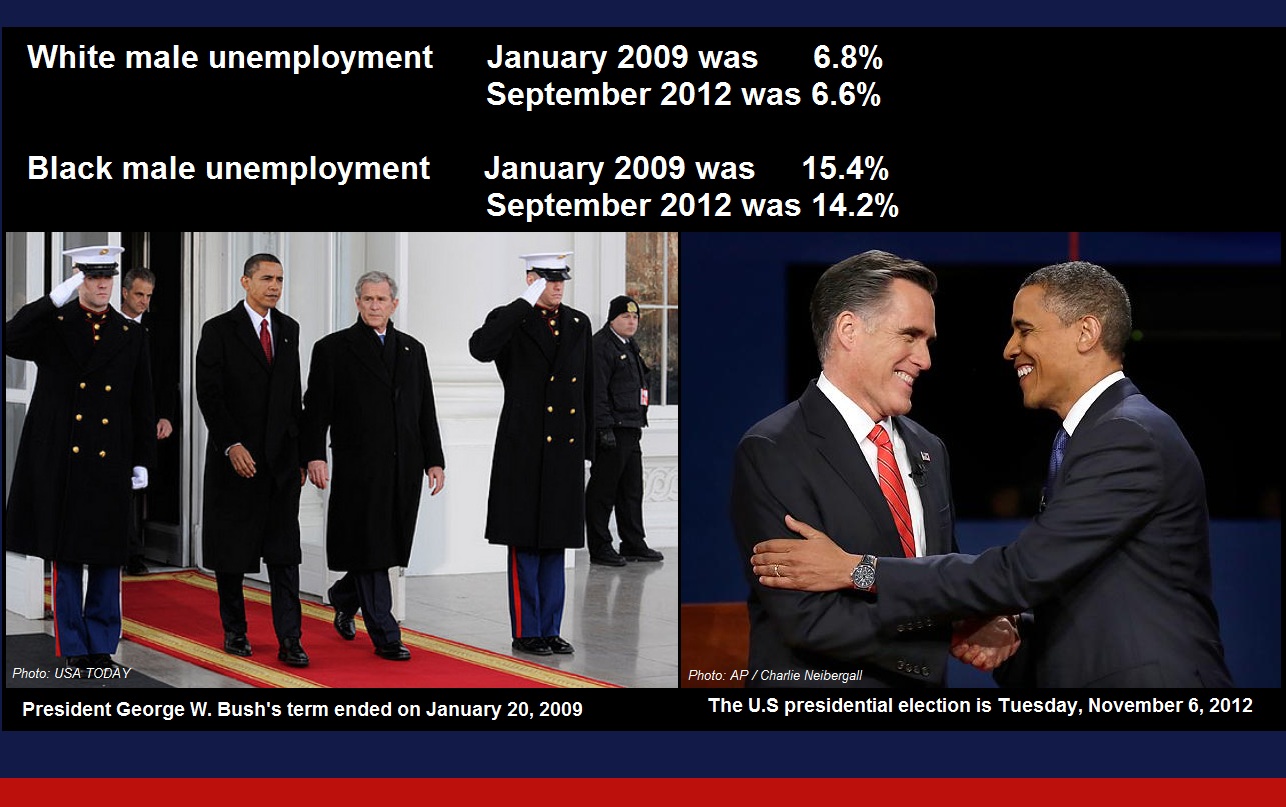
White male and Black male unemployment now lower than when George Bush left office in January 2009
The unemployment rate decreased to 7.8 percent in September, and total nonfarm payroll employment rose by 114,000, the U.S. Bureau of Labor Statistics reported today. Employment increased in health care and in transportation and warehousing but changed little in most other major industries.
The unemployment rate declined by 0.3 percentage point to 7.8 percent in September. The number of unemployed persons, at 12.1 million, decreased by 456,000 in September.
Among the major worker groups, the unemployment rates for adult men (7.3 percent), adult women (7.0 percent), and whites (7.0 percent) declined over the month.
The unemployment rates for teenagers (23.7 percent), blacks (13.4 percent), and Hispanics (9.9 percent) were little changed. The jobless rate for Asians, at 4.8 percent (not seasonally adjusted), fell over the year.
In September, the number of job losers and persons who completed temporary jobs decreased by 468,000 to 6.5 million.
The number of persons unemployed for less than 5 weeks declined by 302,000 over the month to 2.5 million. The number of long-term unemployed (those jobless for 27 weeks or more) was little changed at 4.8 million and accounted for 40.1 percent of the unemployed.
Total employment rose by 873,000 in September, following 3 months of little change. The employment-population ratio increased by 0.4 percentage point to 58.7 percent, after edging down in the prior 2 months. The overall trend in the employment-population ratio for this year has been flat.
The civilian labor force rose by 418,000 to 155.1 million in September, while the labor force participation rate was little changed at 63.6 percent.
The number of persons employed part time for economic reasons (sometimes referred to as involuntary part-time workers) rose from 8.0 million in August to 8.6 million in September. These individuals were working part time because their hours had been cut back or because they were unable to find a full-time job.
In September, 2.5 million persons were marginally attached to the labor force, essentially unchanged from a year earlier. (These data are not seasonally adjusted.) These individuals were not in the labor force, wanted and were available for work, and had looked for a job sometime in the prior 12 months. They were not counted as unemployed because they had not searched for work in the 4 weeks preceding the survey.
Among the marginally attached, there were 802,000 discouraged workers in September, a decline of 235,000 from a year earlier. (These data are not seasonally adjusted.) Discouraged workers are persons not currently looking for work because they believe no jobs are available for them. The remaining 1.7 million persons marginally attached to the labor force in September had not searched for work in the 4 weeks preceding the survey for reasons such as school attendance or family responsibilities.
Total nonfarm payroll employment increased by 114,000 in September. In 2012, employment growth has averaged 146,000 per month, compared with an average monthly gain of 153,000 in 2011. In September, employment rose in health care and in transportation and warehousing.
Health care added 44,000 jobs in September. Job gains continued in ambulatory health care services (+30,000) and hospitals (+8,000). Over the past year, employment in health care has risen by 295,000.
In September, employment increased by 17,000 in transportation and warehousing. Within the industry, there were job gains in transit and ground passenger transportation (+9,000) and in warehousing and storage (+4,000).
Employment in financial activities edged up in September (+13,000), reflecting modest job growth in credit intermediation (+6,000) and real estate (+7,000).
Manufacturing employment edged down in September (-16,000). On net, manufacturing employment has been unchanged since April. In September, job losses occurred in computer and electronic products (-6,000) and in printing and related activities (-3,000).
Employment in other major industries, including mining and logging, construction, wholesale trade, retail trade, information, professional and business services, leisure and hospitality, and government, showed little change over the month.
Source: U.S. Bureau of Labor Statistics | Division of Labor Force Statistics
________________________________________________
The Great Recession by the numbers
Dilemma X
The Great Recession and the Global Financial Crisis began in December 2007. The financial crisis was triggered by a complex problems in the United States banking system, the U.S. housing bubble and other financial failures.
Past July unemployment rates:
September 2012 was 7.8% The number of unemployed persons was 12.1 million September 2011 was 9.1%
The number of unemployed persons was 14.0 million September 2010 was 9.6%
The number of unemployed persons was 14.8 million September 2009 was 9.8%.
The number of unemployed persons was 15.1 million.
President Barack Obama assumed office January 20, 2009.
In January 2009 the number of unemployed persons was 11.6 million and the unemployment rate was 7.6%.
Unemployment peaked in October 2009 with an unemployment rate of 10.2% and 15.7 million unemployed persons.
White male unemployment, 20 years and over, in December 2008 was 6.5% and White female unemployment, 20 years and over, was 5.5%.
White male unemployment, 20 years and over, in January 2009 was 6.8% and White female unemployment, 20 years and over, was 5.8%.
White male unemployment, 20 years and over, in September 2009 was 9.6% and White female unemployment, 20 years and over, was 7.0%.
White male unemployment, 20 years and over, in October 2009 was 9.9% and White female unemployment, 20 years and over, was 7.4%.
White male unemployment, 20 years and over, in September 2012 that number for White men is 6.6% and White female unemployment, 20 years and over, was 6.3%.
____________________________
African American male unemployment, 20 years and over, in December 2008 was 13.4% and African American female unemployment, 20 years and over, was 8.9%.
African American male unemployment, 20 years and over, in January 2009 was 15.4% and African American female unemployment, 20 years and over, was 9.2%.
African American male unemployment, 20 years and over, in September 2009 was 16.5% and African American female unemployment, 20 years and over, was 12.5%.
African American male unemployment, 20 years and over, in October 2009 was 17.1% and African American female unemployment, 20 years and over, was 12.4%.
African American male unemployment, 20 years and over, in September 2012 was 14.2% and African American female unemployment, 20 years and over, was 10.9%.
_______________________________________
Tuesday, November 6, 2012 is the next United States presidential election.
In November 2009 the number of unemployed persons was 15.4 million, and the unemployment rate was 10.0%.
In November 2010 the number of unemployed persons was 15.1 million and the unemployment rate was 9.8%.
In November 2011 the number of unemployed persons was 13.3 million and the unemployment rate was 8.6%.
Between January 2009 and March, 2009 more than 2 million jobs were lost and 663,000 were lost in March 2009 alone. The number of unemployed persons increased to 13.2 million that month.
________________________________________________
George W. Bush served as the 43rd President of the United States from January 20, 2001 – January 20, 2009.
September 2001 the nation’s unemployment rate was 4.9% with a total of 7 million unemployed persons
September 2008 the nation’s unemployment rate was 6.1% with a total of 9.5 million unemployed persons
January 2009 the nation’s unemployment rate was 7.6% with a total of 11.6 million unemployed persons. For whites the unemployment rate was 6.9% and for African Americans it was 12.6%.
Bill Clinton served as the 42nd President of the United States from January 20, 1993 – January 20, 2001.
September 1994 the nation’s unemployment rate was 5.9% with a total of 7.7 million unemployed persons.
September 2000 the nation’s unemployment rate was 3.9% with a total of 5.5 million unemployed persons. Unemployment rate was the following: whites 3.5% and for blacks 7.0%.
April 2000 -For whites the unemployment rate was 3.5% and for African Americans it was 7.2%.
This is the first time the nation’s unemployment rate had been below 4.0% since January 1970. January 2001 the nation’s unemployment rate was 4.2%. The number of unemployed persons rose to 5.95 million.
Seasonal adjustmentis a statistical method for removing the seasonal component of a time series used when analyzing non-seasonal trends. Whereas, not-seasonally-adjusted reflects the actual current data. It is normal to report not-seasonally-adjusted data for current unemployment rates. Seasonally adjusted data may be used for the longer term comparison.
Total employment and unemployment vary throughout the year. For example,higher unemployment in January and February isn’t uncommon because of work in agriculture, construction and other seasonal industries slowing down. Also, both employment and unemployment rise every June, when students enter the labor force in search of summer jobs. Seasonally adjusted numbers also take into account seasonal hiring/layoff patterns that go along with winter and summer holidays.
____________________________________________
Video: Ronald Reagan and the 1982 Recession
___________________________________________
Video: President Reagans Address to the Nation on the Economy February 5, 1981
___________________________________________
During Ronald Reagan’s first term unemployment peaked at 10.8% in November 1982. By the time of the 1984 election the jobless rate had fallen to 7.3%.
The Reagan Recession officially lasted from December of 1980 to November of 1982. Unemployment did not reach its pre-recession level until May of 1984.
In February 1981 Reagan presented the Economic Tax Recovery Act to Congress, calling for massive personal and corporate tax cuts, reductions in government spending, and a balanced budget. The program was based on supply side economics: Tax cuts, the theory went, would allow people either to spend more on goods and services, thus giving the economy a boost, or to invest in businesses, thus leading to economic growth. The economic expansion, supply side theorists argued, would generate enough revenue to cover the shortfall resulting from the initial cut in tax rates.
In August 1981, President Reagan signed his Recovery Act into law.
The United States was experiencing its worst recession since the Depression, with conditions frighteningly reminiscent of those 50 years earlier. By November 1982, unemployment reached, nine million, the highest rate since the Depression; 17,000 businesses failed, the second highest number since 1933; farmers lost their land; and many sick, elderly, and poor became homeless.
Reagan’s approval rating hit rock bottom. In January 1983, it was estimated at a dismal 35 percent. Having failed in his promise to deliver economic prosperity, Reagan’s reelection in 1984 seemed unlikely.
While Reagan finally agreed to a moderate tax increase on businesses, he steadfastly refused to raise income taxes or cut defense spending, despite a growing negative sentiment toward the buildup.
In January 1983, with his approval rating at an all-time low, the economy slowly began to right itself. Unemployment, as high as ten percent in 1982, had improved enough by 1984 for his popularity to be restored, and by the November presidential election, it was hard to believe that a second term was ever in doubt.
Dilemma X, LLC provides research dedicated to the progression of economic development. Our services aid clients in enhancing overall production statistics.
Please visit http://www.dilemma-x.com for more information



 Dilemma X
October 5, 2012
U.S. unemployment rate