
Atlanta to Charlotte Passenger High Speed Rail Corridor Investment Plan

Georgia Department of Transportation
The National Environmental Policy Act (NEPA) requires agencies to publish an Environmental Impact Statement (EIS) when planning a project that will significantly affect the environment. The Georgia Department of Transportation (GDOT), which is leading the Atlanta to Charlotte Passenger Rail Corridor Investment Plan (PRCIP) project on behalf of the Federal Railroad Administration, will complete its EIS for the project in “tiers” of environmental review. The first round – or Tier 1 EIS – will analyze passenger rail service between Atlanta, Ga., and Charlotte, N.C., on a broad scale.

Atlanta to Charlotte PRCIP Tier 1 EIS
The Atlanta to Charlotte PRCIP Tier 1 EIS is a document that provides a complete picture of the high-speed passenger rail study between the two cities. The Tier 1 EIS describes the need for and purpose of the Atlanta to Charlotte PRCIP project, and it identifies potential corridor alternatives, station locations and levels of service.
The project team will carefully consider the potential environmental, economic and social effects of each corridor alternative. They will also conduct a conceptual engineering and financial analysis to come up with ridership, cost and revenue estimates for each corridor alternative. GDOT will use all of this information to select its preferred project alternative.
The EIS will include comments about the Atlanta to Charlotte PRCIP from the public, and local, state and federal agencies. Preparation of the EIS allows environmental effects to play an important role – along with other factors such as feasibility and cost – in decisions made about the potential project.
A Service Development Plan (SDP) for the preferred alternative will include the final Atlanta to Charlotte PRCIP operational characteristics and capital costs, and it will outline phases for and implementation of the project.
Project Need
Interim roadway improvements in the major metropolitan areas of Atlanta and Charlotte, and Greenville, and Spartanburg, S.C., likely will not satisfy long-term capacity and mobility needs for the corridor. Alternative transportation choices such as high-speed rail are needed to combat increased traffic congestion, crash rates and air pollution from vehicles’ greenhouse gas emissions.
Project Purpose
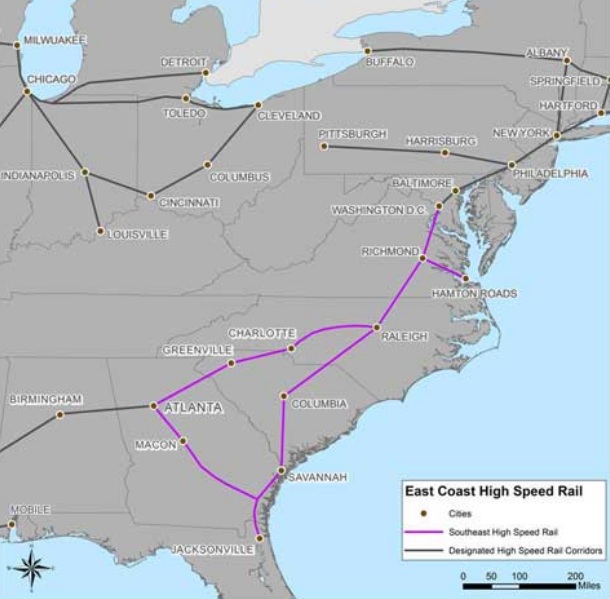
The corridor between Atlanta and Charlotte, and the region as a whole, is facing serious mobility challenges that if left unaddressed, will negatively affect local, regional and national economies as identified in the project purpose and need and Scoping Document. The existing transportation infrastructure is outdated, congested, disconnected and has limited reliable passenger mode choices. The purpose of the Atlanta to Charlotte Passenger Rail Corridor Investment Plan project is to improve intercity travel and mobility between Atlanta and Charlotte with improved passenger rail services. The corridor would also be an important extension of the planned regional Southeast High Speed Rail system to connect other East Coast metropolitan areas such as Washington D.C., New York and Boston.
Project Schedule
Click image to enlarge. Click your back arrow to return to Dilemma X

Study Area
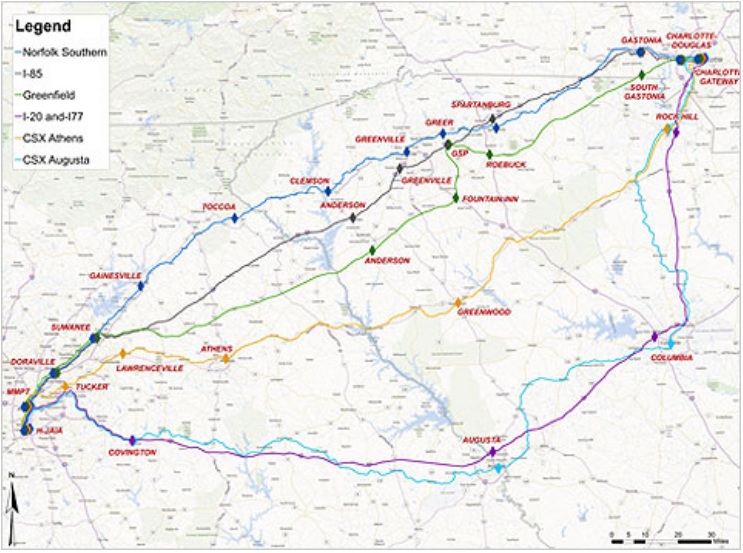
The Atlanta to Charlotte Passenger Rail Corridor Investment Plan (PRCIP) high-speed rail corridor connects the two cities in a general northeast direction for an approximate distance of 280 miles. Other connections may include Greenville and Spartanburg, S.C., among others. The exact starting and end points for the Atlanta to Charlotte PRCIP study will be finalized through an alternatives development analysis, which will address connections to the proposed Georgia MultiModal Passenger Terminal; Hartsfield-Jackson Atlanta International Airport; the proposed Charlotte Gateway Station multimodal facility; and Charlotte-Douglas International Airport; as well as connections to the planned Charlotte to Raleigh high-speed rail service.
In 2008, the Volpe Center published the “Evaluation of High-Speed Rail Options in the Macon-Atlanta-Greenville-Charlotte Rail Corridor” report, which evaluated a variety of routes and technology options. Based on this work, two route alternatives have been initially identified between Atlanta and Charlotte:
1. The Crescent Corridor, owned by Norfolk Southern Railway, which is now used by Amtrak to provide passenger rail service; and
2. The I-85 Interstate corridor, which offers grade-separated, publicly owned right of way between the two cities.
A to-be-identified “greenfield” alternative(s) offers the opportunity to define a fully grade-separated route (full separated from other modes of traffic with bridges and tunnels at roadway intersections) which provides for straighter track allowing for high-speed passenger rail service. Greenfield refers to a new alignment on new location and would be located outside of any existing transportation right-of-way, in most cases. Other alternatives might also be identified if they meet the basic requirements of the purpose and need for the Atlanta to Charlotte PRCIP corridor.
_____________________

May 2012 North Carolina and Virginia have presented the Federal Railroad Administration (FRA) with a report that identifies the two state’s recommendations for the preferred rail alternative for each of the 26 sections of the SEHSR corridor between Richmond, VA, and Raleigh, NC.
In the summer of 2010, the North Carolina Department of Transportation (NCDOT) and the Virginia Department of Rail and Public Transportation (DRPT) held a series of Public Hearings on a Draft Tier II Environmental Impact Statement (DEIS) for the Richmond, VA, to Raleigh, NC, portion of the SEHSR corridor. In response to comments on the DEIS, a new rail alternative has been developed for downtown Raleigh (between Whitaker Mill Road and the Boylan Wye).

_______________
Atlanta
City limit population: 443,775
Atlanta–Athens-Clarke County–Sandy Springs, GA metro CSA: 6,092,295
Hartsfield-Jackson Atlanta International Airport
Word Rank 1 with 930,250 Take-off and Landings (2012) US Rank 1
Word Rank 1 with 95,462,867 Passenger Traffic (2012) US Rank 1
Video: Atlanta Skyline
_____________________
Video: MARTA Rail
___________
__________
Charlotte

City limit population: 775,202
Charlotte-Concord, NC-SC metro CSA: 2,454,619
Charlotte-Douglas International Airport
Word Rank 7 with 552,093 Take-off and Landings (2012) US Rank 6
Word Rank 23 with 41,228,372 Passenger Traffic (2012) US Rank 8
Video: Charlotte Skyline
_______________
Video: Charlotte Area Transit System (CATS) Lynx Blue Line
_______________
_______________


 Dilemma X
May 29, 2013
Did you know?