
June 8, 2012
How the man cured of HIV has inspired doctors to discover revolutionary new treatment
By Brian Clark Howard
Daily Mail
Timothy Brown, 46, became the first person in history to be cured of HIV after receiving a blood stem cell transplant from a person resistant to the virus.
In 2007 doctors made the breakthrough surgery as they treated Brown for the leukemia that he had been diagnosed with a year earlier.
And now doctors are one step closer to emulating the success of Brown’s surgery to help the estimated 34 million people worldwide who are HIV positive.
Experts hope that umbilical cord blood transplants could provide a similar solution to Brown’s in curing the virus.
Brown – often known as ‘The Berlin Patient’ because he formerly lived in that city – first tested positive for HIV in 1995.
In 2007, when he was still living in Germany, Mr Brown was undergoing extensive treatment for leukemia.
During the course of his treatment, doctors gave him a bone marrow stem cell transplant from a donor with a genetic mutation that made him immune from HIV.
The mutation, called delta 32, occurs in an estimated 1 per cent of people descended from Northern Europeans, with Swedes being the most likely candidates.
The percentage is far less than in people of other races. In 2007 Brown’s doctors tested nearly 70 donors before they found a match.
However, stem cell transplant isn’t feasible as a widespread treatment for HIV patients because it is often very difficult to find a matching bone marrow donor, and much harder to find one who also carries the HIV-resistant gene.
Conversely the match between donor and recipient in umbilical cord transplants does not need to be so close, according to Dr. Lawrence Petz, medical director of StemCyte, an umbilical cord blood bank.
Petz told ABC News that Brown’s transplant was made more complicated because the blood stem cells came from an adult donor.
‘When you do that [stem cell transplants] you have to have a very close match between donor and recipient,’ Petz told the news station. ‘With umbilical cord blood, we don’t need such a close match. It’s far easier to find donor matches.’
However, out of 17,000 samples of cord blood Petz and his colleagues have found only 102 cord with the genetic HIV-resistant mutation – so the bank needs to be built up over time.
‘At the present time, I feel there’s no other way to cure a reasonable number of patients other than using cord blood,’ Petz told Fox News.
The first cord blood transplant on an HIV infected patient from the Netherlands was performed a few weeks ago and Petz’s team have another transplant lined up for a patient in Spain later this month.
It will take months before researchers can tell if the treatment has made any difference to the patient’s HIV.
‘We don’t know the final outcome yet, but we’re very optimistic that the transplant will be of significant benefit to the patient,’ Petz told Fox.
Like in Brown’s case, the transplants aren’t carried out solely to treat AIDS, the patients have an additional condition that requires the transplant.
‘It can be done. It’s just a matter of time,’ Petz said of finding a cure.
Since his transplant Brown’s body shows no signs of HIV. ‘I feel good,’ Brown told ABC News. ‘I haven’t had any major illnesses, just occasional colds like normal people.’
Brown, who feels guilty to be the only person to have been cured of the illness, hopes his story will inspire sufferers that a cure is possible.
‘I don’t want to be the only person in the world cured of HIV. I want a cure for everyone,’ he said.
__________________________________________________
Published June 07, 2012
Doctors turn to cord blood transplants in hopes of curing patients with HIV
By Alex Crees
FoxNews.com
Timothy Brown made medical history when he became the first patient who was essentially cured of HIV, after receiving a stem cell transplant from a person who was genetically resistant to the infection. Now, doctors are hoping to build on Brown’s success by treating HIV patients using cord blood units that have the same HIV-resistant gene.
Brown, 46, was a student living in Berlin in 1995 when he tested positive for HIV. He responded well to therapies for the disease until 2006, when doctors also diagnosed him with acute myeloid leukemia.
The doctor who treated Brown, Dr. Gero Hütter from Berlin’s University Hospital, proposed to tackle his leukemia by using chemotherapy to wipe out his immune system, and then rebuild the immune system with a bone marrow transplant.
However, when searching for an appropriate match, Hütter kept his eyes out for a specific donor: one who carried a genetic mutation called delta 32, which disables the CCR5 receptor on immune system cells. The CCR5 receptor is the one HIV uses to infect its victims – meaning people who carry the mutation are essentially immune to the disease. Approximately one percent of Europeans carry the mutation, but it is rarer people of African, Asian, or South American descent.
Out of 232 potential donors, Hütter found a match for Brown, who also carried the delta 32 mutation, on the 67th try. The doctors performed the transplant, repopulating Brown’s bone marrow cells with the donor cells. Months later, Brown was in remission for leukemia and had no trace of HIV in his body.
And while Brown’s leukemia eventually recurred a year later, necessitating another transplant, his HIV never did.
“I still have some disabilities due to the treatments – it’s not perfect,” Brown told FoxNews.com, explaining that he suffered from speech and balance issues following the procedure. “But it is my life, and I’m very happy not to have to worry about HIV anymore.”
However, Brown’s stem cell transplant isn’t feasible as a widespread treatment for HIV patients, according to doctors. It can be highly difficult to find a matching bone marrow donor – let alone one who also carries the HIV-resistant gene.
“The cord blood idea came about later because of the success with my transplant,” Brown said. “…In my case, using stem cells, they had to find a perfect match for me. With cord blood, you don’t have to use donors that are an exact match, so it means doctors are more likely to find a donor who will work.”
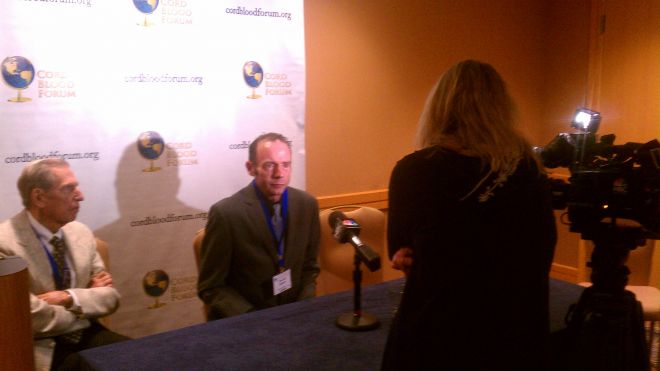
Dr. Lawrence Petz, a stem cell transplantation specialist, as well as chief medical officer for StemCyte and president of the Cord Blood Forum, explained cord blood essentially gives doctors more leeway in regards to matching patients with donors and opens the possibility of treating many more people.
“At the present time, I feel there’s no other way to cure a reasonable number of patients other than using cord blood,” Petz said.
Two weeks ago, a patient in the Netherlands was the first to undergo this potentially revolutionary treatment. As was the case with Brown, the transplant was primarily done to address another disease, but doctors specifically selected a unit of cord blood that contained the HIV-resistant gene in hopes of curing that as well. Another similar surgery is scheduled for a patient in Madrid within the month.
“We don’t know the final outcome yet, but we’re very optimistic that the transplant will be of significant benefit to the patient,” Petz said. “Usually it takes some months after the procedure to determine the outcome [while the recipient’s cells are being repopulated with the donor cells], so we’re keeping an eye on it very closely because it could be of historic interest.”
Petz explained that as of now, the treatment isn’t meant for all HIV patients. The inventory of cord blood units that carry the HIV-resistant gene – 100 out of 17,000 tested so far – needs to be built up over time.
Petz said he believes HIV patients with other hemolytic disorders, such as Brown and the Netherlands patient, and AIDS patients who do not respond well to current drugs on the market, should be considered for the transplants.
__________________________________
June 18, 2012
Trainer’s secret is too big a weight to bear


Today he can bench press 350 pounds, and two years ago he biked from Raleigh to Washington, 330 miles, in three and a half days.
Misty Dawn Hill was born when Rob Hill was 17. He’s lived in another state for most of her life, but they’ve stayed close, talking on the phone at least once a week, Hill says.
Now, as a stay-at-home mom with a 2-year-old son and five stepchildren, she was ready to hear, Hill said.
He wasn’t so sure about his father, J.W. Hill, a 25-year Vietnam veteran now retired in Arizona.
“I’m afraid that he might disconnect with me,” Hill said.
Hill first tried marijuana at 13, the same year his parents divorced.
By 23, he had dropped out of high school, married and divorced Misty’s mother, and had moved to California.
For four years he worked as a DJ, ushered country music stars like Tammy Wynette and Garth Brooks on and off stage until 2 a.m., then partied with co-workers until 7 or 8 in the morning.
After work he routinely shared a needle to inject drugs in his veins. Sometimes he didn’t know what was in the drug cocktail, but he tried it all – cocaine, heroine, speed, acid.
‘It woke me up’
Hill only remembers one thing from that day.
He stopped taking drugs. He wouldn’t even take the antiretrovirals his doctors prescribed to prevent AIDS.
He moved to North Carolina to stay with his mother and sever the relationships with old friends.
For about six months, he huddled in a chair, wrapped in a beige and blue afghan Brown had crocheted, to break his addiction.
Now he is militant about what he puts in his mouth: no chemicals, no processed foods. He preaches that mantra to his clients at the gym.
His story and the changes he’s made are inspiring, she said.
Hill is one of eight HIV-positive patients in an ongoing study at UNC, where researchers are using a drug used to treat lymphoma to lure the virus out of hiding. Researchers will examine the immune system’s response to the virus and the drug’s effect on the body.
His antiretroviral medication costs $3,700 a month, covered by health insurance. He takes seven pills, four times a day.
“I really don’t have close friends. I have a trust issue I think in some regards and also the food was a big issue as well. If you’re trying to reel yourself in with food, it’s hard to be around most people because they want to feed you bad food,” he said.
“Eliminating stress was a big issue as well; the average stress a relationship brings is too much for me,” he said.
He let the secret go with one person at a time week by week.
Now he has begun to.


 Dilemma X
June 10, 2012 at 7:50 pm
The article about Stem Cells is interesting, but many African Americans and others who believe they have AIDS/HIV, may not have AIDS at all.
If you carefully read what the producers of these AIDS tests say in writing, they suggest the AIDS/HIV test is not conclusive, or proof you have AIDS/HIV. You can also find on the Internet additional information suggesting; “Since the accuracy for HIV antibody tests has never been properly established, it is not possible to claim that a positive test indicates a current, active HIV infection or even to know what it may indicate”.
If we go beyond the fact AIDS/HIV is a man-made genetically engineered disease, proved by Virologist as early as 1988 and exposed by Dr. Robert B. Strecker in his Video The Strecker Memorandum, in addition to the research of Brother Zears Miles, we really need to look at what the disease is and how it replicates.
For a Stem Cell to cure AIDS/HIV, it would have to inhibit the Protein Enzyme, Reverse Transcriptase. The AIDS/HIV Virus must have this protein enzyme to replicate, or reproduce itself. So if the Stem Cell therapy is not inhibiting this enzyme, people may line up for another unproven cure, the same as they line up to be tested for a disease which they my receive a “False Positive” test results. Africans and other dark skinned people naturally have fewer “T-Cells” than white people and many of the African, or black population when tested have been proven to be “False Positive” because of their naturally low T-Cell Count.
Many of the drugs used to supposedly cure AIDS/HIV are synthetic drugs, which try to block the reverse transcriptase, but actually do the same damage AIDS does, by destroying the Immune System. As victims continue to take these drugs, their Immune Systems are further depressed and the worry only adds to an ineffective Immune System, which is unable to fight off any illness. The human body is organic and as early as 1900, it was proven that all drugs, including aspirin are harmful to your good health.
The interesting point of cure, as far as AIDS is concerned, is that the doctors and scientists who have given cures or evidence of what has cured AIDS, Cancer and other diseases have been attacked by the American Medical Association and the U.S. Government. The Medical Industry has suppressed the Truth of Natural Cures for over a hundred years.
Many diseases have been completely remedied by proper diet, while others means have been Herbs. It wasn’t until mid 1990’s that scientists rediscovered the power of natures remedy for the majority of viruses, bacteria, and fungus and among the strongest natural antibiotic the Olive Leaf Extract, used for thousands of years and known as the Tree Of Life by the Ancients. Interestingly enough, scientists found that the Olive Leaf Extract inhibits the Enzyme Reverse Transcriptase, kills almost all Bacteria, Virus and Fungus.
So we are led astray constantly with lies and additional lies of drugs, testing and now Stem Cells, the really big question is, “Where Is The Proof”.
Change your diet and change your life, eat more raw live foods and drink more fresh squeezed juices. That type of diet is the cure of most disease and has been proven since 1912 in the U.S.
Good Luck To you All
UMOJA Research
Since 1986
AIDS, Cancer, Disease, Causes and Cures, Nutrition & Agriculture
Ref
1. Olive Leaf Extract, Dr. Morton Walker
2. Nutrition Against Disease, Roger J. Williams
3. Racketeering in Medicine, The Suppression of Alternatives, James P. Carter, M.D., Dr.P.H
4. DVD, The Strecker Memorandum, Dr. Robert B. Strecker
5. DVD, Cancer The Forbidden Cures, Massimo Mazzucco
6. DVD, Dying To Have Known, The Evidence Behind Natural Healing, Steve Kroschel
November 13, 2012 at 10:33 am
Olive leaf (Olea europaea) was first used medicinally in Ancient Egypt. It is gaining recognition as a powerful defender against sickness.