
Hugo Chavez rallies thousands launching re-election bid

Venezuela’s President Hugo Chavez acknowledges supporters before the registration of his presidential bid to the electoral authorities in Caracas June 11, 2012. REUTERS/Carlos Garcia Rawlins
By Fabiola Sanchez
Associated Press
CARACAS, Venezuela — Venezuelan President Hugo Chavez rallied tens of thousands of supporters Monday, wearing his signature red beret and singing a folk song as he launched his re-election bid.
Chavez waved and blew kisses to crowds while he rode atop a truck to the country’s elections office, then picked up a document registering as a candidate. Afterward, he stepped onto a stage and energetically sang along with a band to a traditional tune from the rural plains where he was born. Chavez laughed and danced briefly on stage.
The 57-year-old president, a former army paratroop commander first elected in 1998, is seeking another six-year term in the Oct. 7 presidential vote. His struggle with cancer has recently forced him to scale back his public appearances and has raised questions about whether his health may interfere with the re-election campaign.
“I want to thank my Lord that I’m here today. … It was a difficult year,” Chavez said in a speech to cheering crowd. “Here I am, before you again!”
He denied rumors of worsening health, calling such speculation “psychological warfare” waged by his adversaries.
“We’re just warming up our engines,” he said, vowing to win the vote in a “knockout.”
As Chavez registered his candidacy, he walked slowly greeting allies and elections officials. The crowd outside chanted: “Ooh-Ah! Chavez’s isn’t going away!”
His supporters and government employees wore their socialist party’s red caps and shirts, holding photos of the president and signs reading: “We’re giving it our all, out of love for Chavez.” Three giant inflatable likenesses of Chavez rose above the crowd that surrounded the elections office.
Chavez wore a track suit in the yellow, blue and red of Venezuela’s flag as he rode through streets lined with supporters on his way to the elections office. Confetti floated in the air as he passed. Some in the crowd waved flags, and others blew whistles and horns.
Chavez was accompanied by relatives including his brother Adan and two daughters.
Adela Blanco, who works at a government food processing company, said she thinks Chavez has been looking better lately despite his illness. “He has to rest. He has to recover in order to continue on,” she said.
Chavez’s rival, Henrique Capriles, led a huge crowd of supporters Sunday as he registered his candidacy, working up a sweat by marching and jogging 6 miles (10 kilometers) from a park in eastern Caracas to the headquarters of the National Electoral Council.
Climbing up on a stage in a plaza next to the elections office, Chavez spoke for more than 2 1/2 hours. He said he hopes to expand his drive to build a socialist state, and presented elections officials with what he described as a socialist plan for his government through 2019.
Chavez didn’t mention Capriles by name but said his rival’s speech a day earlier was bland and colorless. Chavez dismissed his opponents as “mamas’ boys who never studied,” and said they will be swept away in the upcoming election.
Some Venezuelan analysts have said they expect Chavez’s illness could be a point against him in the presidential campaign, especially if his condition limits his strength and mobility. Despite his illness, though, Chavez’s approval ratings have remained above 50 percent during the past year, and recent polls put him in the lead the over Capriles.
Elisa Bermudez, a retiree who held a sign bearing an image of Chavez, said she hopes he wins re-election in order to continue the social programs he has created. Programs offered by Chavez’s government include cash benefits for poor families and neighborhood health clinics staffed by Cuban doctors.
Asked if she thinks Chavez is well enough to campaign, Bermudez said: “We’ll help him.”
Luis Vicente Leon, who heads the Venezuelan polling firm Datanalisis, said Chavez has managed his illness in a way that has allowed him to benefit politically so far while also avoiding having the bulk of the Venezuelan population “believe it’s a deadly illness that will impede Chavez’s future.”
As the vote nears, though, Chavez will likely have to adjust his strategy to show he is well enough to campaign in order to avoid potential fallout, Leon said.
Chavez said Saturday that he has undergone tests following his cancer treatment and everything came out well.
The president returned from Cuba on May 11 after what he said was a difficult round of radiation therapy.
In the past year, Chavez has undergone two surgeries that removed tumors from his pelvic region, most recently in February. During Chavez’s yearlong cancer struggle, he has not disclosed key details about his illness including the type of cancer or the precise location of the tumors.
Both during and after his cancer treatments, Chavez has appeared in public less frequently than he used to, a dramatic shift for a leader who for much of his 13-year-old presidency has kept a busy schedule of televised talks and rallies.
While Chavez has taken a lower profile, his government has stepped up advertising that promotes his image and programs such as public housing construction. Some of Chavez’s Cabinet ministers have taken to wearing T-shirts emblazoned with a simple image showing only Chavez’s eyes.
In his speech, Chavez didn’t say how active he intends to be during the campaign. But he did say he soon plans to attend the inauguration of a new mausoleum to house the remains of 19th century independence hero Simon Bolivar.
His government has built a new mausoleum with a soaring, curved roof for the namesake of Chavez’s Bolivarian Revolution movement. Bolivar’s birthday, a national holiday, is coming up on July 24.
______________________________
Hugo Chávez
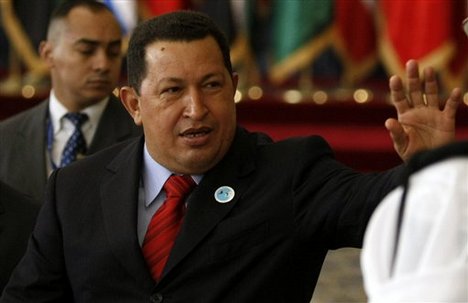
Hugo Chávez is the first president in Venezuela’s history to claim and honor his Indigenous and African ancestry.
An estimated 100,000 enslaved Africans were brought to Venezuela between the 16th and 19th centuries. Most were sold to the central coastal states.
Abolition occurred in 1854, but freedom did not bring equality. Racism continued to flourish in Venezuela throughout most of the 20th century, and African heritage was denied through an emphasis on racial mixing. The mestizo, born of European, Indigenous, and African blood, became a cornerstone of national identity. In this scheme, Blackness was devalued to such an extent that state policies sought to “whiten” the population through European immigration.
Since the first election of President Chávez in 1998, reforms have been gradually instituted to address the problems faced by the Afro-Venezuelan community and to extend to them important social, political, and economic rights. These reforms included the recognition of intercultural education in the 1999 Constitution, a diversity of social programs and new laws. For example, in 2005 President Chávez approved Presidential Decree No. 3645 that established the Presidential Commission for the Prevention and Elimination of all Forms of Racial Discrimination in the Venezuelan Educational System.
In 2005 President Hugo Chávez approved Presidential Decree No. 3645 that established the Presidential Commission for the Prevention and Elimination of all Forms of Racial Discrimination in the Venezuelan Educational System.
Also, in 2005 the Venezuelan National Assembly officially designated May 10 Afro-Venezuelan Day (Día de la AfroVenezolanidad). Other advances also include the establishment of the Vice Ministry for African Affairs. Additionally, this coming May the approval of a national law against racial discrimination and intolerance is by the National Assembly is expected.
In August 2009 a new Organic Law of Education was approved addressing the rights of Afrodescendants in five of its articles, and opening the door to formulating new regulations dealing with specific issues concerning the Afro-descendant community. “The law requires that educational institutions teach the history of African descendants and prohibits the media from conveying messages of discrimination against Indigenous Peoples and Afro-descendants.”
With the 1999 Constitution, Venezuela became the second Latin American country after Cuba to guarantee all citizens the right to basic healthcare.
Since 2003, millions of AfroVenezuelans have been issued national ID cards guaranteeing them the citizenship rights they previously lacked. Article 56 of the 1999 Constitution guarantees all persons the right to free registration with the Civil Registry Office, a measure which has allowed electoral participation among Afro-Venezuelans to grow tremendously.
For the first time ever, Venezuela’s 2011 Census included a question that allows individuals to identify themselves as being Afro-descendent.
Source: Embassy of the Bolivarian Republic of Venezuela to the United States
_________________________________
Venezuela
Venezuela is slightly more than twice the size of California and has a population of 28,047,938 (July 2012 est.)
Ethnic groups
Europeans: Spanish, Italian, Portuguese, German
Arab
African
indigenous (Amerindian)
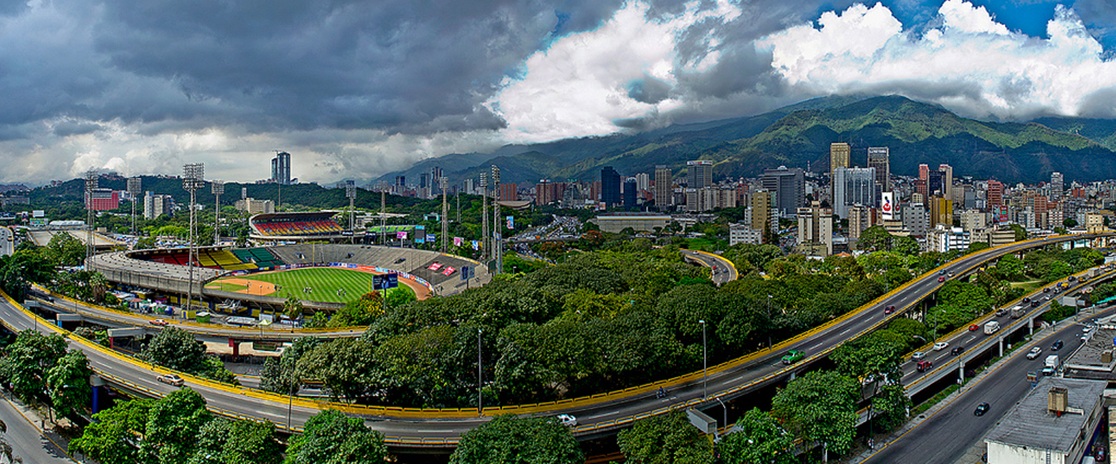
Caracas
(capital) population 3.051 million

_________________________________
Video: Caracas subway
_________________________
Video: Afro-Venezuelans and Hugo Chavez


 Dilemma X
June 11, 2012
International